
Asian judoka have made a strong impression through the first two days of the Hungary Grand Slam 2026, with Japan collecting three gold medals and Mongolia producing one of the tournament’s breakthrough performances at the final IJF World Judo Tour event before a major autumn of international judo.
The Grand Slam, being held in Budapest from 11 to 13 September, has attracted 504 judoka from 67 countries, including 52 competitors representing nine Judo Union of Asia member nations.
For Asian teams, Budapest carries additional importance. The 20th Asian Games Aichi-Nagoya 2026 judo competition begins on 30 September, followed immediately by the World Championships in Baku from 4 October.
Funakubo Opens Japan’s Gold Medal Account
Japan’s first title came on Friday in the women’s -57 kg category, where Olympic bronze medallist Haruka Funakubo defeated Olga Mukhina in the final.
Mukhina initially moved ahead with a yuko, but Funakubo — widely recognised for the strength of her ne-waza — responded by taking the contest to the ground and securing the decisive osaekomi.
The victory adds another major international title to Funakubo’s record. The Japanese judoka was a world silver medallist in both 2022 and 2023 and won bronze at the Paris 2024 Olympic Games.
Japan also collected two bronze medals on the opening day through Tomoka Arakawa (-48 kg) and Ryusei Seki (-66 kg).
Mongolia provided another notable Asian performance in the -66 kg division. Byambasuren Ulziibayar, who arrived in Budapest ranked outside the world’s top 500 and without a major senior international result, advanced all the way to the Grand Slam final before taking silver behind Bulgaria’s Boyan Yotov. The IJF described his run as one of the biggest surprises of the opening day.

Danno and Hojo Double Up on Day Two
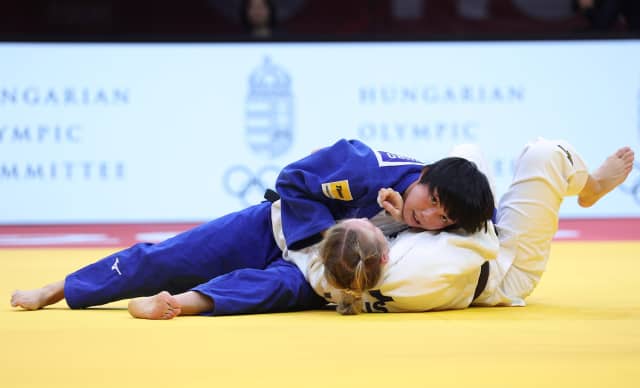
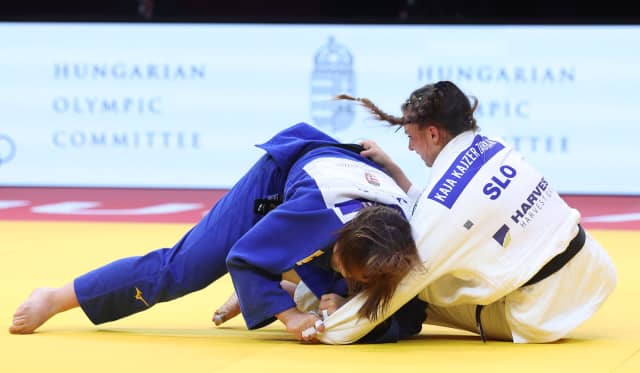
Japan’s momentum continued on Saturday, when Megu Danno won the women’s -63 kg title.
Danno faced Slovenia’s Kaja Kajzer Zabkar in a closely fought final that went into golden score. The Japanese athlete eventually found the decisive opportunity, scoring yuko with ko-uchi-gake to secure the gold medal.
The result continues Danno’s progression on the international circuit. She previously won silver at the Tokyo Grand Slam in 2024 before claiming her first Grand Slam title in Abu Dhabi in 2025.

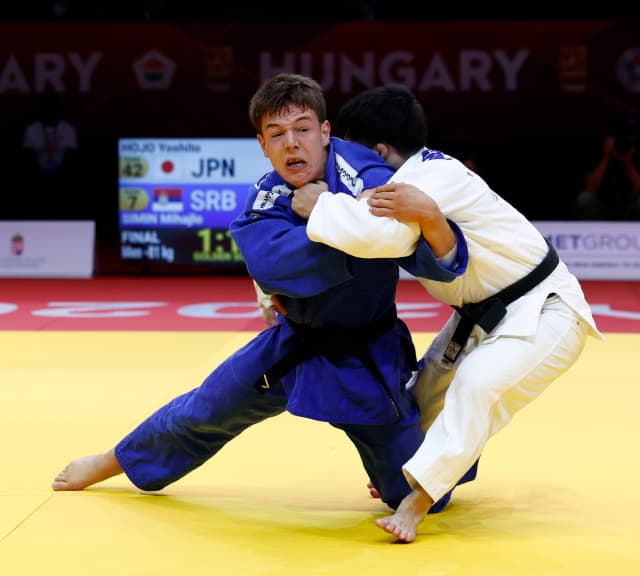
Hojo defeated Serbia’s Mihajlo Simin in the final, adding Budapest gold to an international record that already includes victory at the Dushanbe Grand Slam in 2024 and the Qingdao Grand Prix in 2025, as well as bronze at the Tokyo Grand Slam later that year.
The victories of Funakubo, Danno and Hojo underline the depth of Japan’s current senior programme while also providing important competitive information as Asian federations approach their continental showcase.
Budapest Provides Final International Test
The Hungary Grand Slam concludes on Sunday with the heavier categories: women’s -78 kg and +78 kg and men’s -90 kg, -100 kg and +100 kg.
The timing makes every performance particularly relevant for the Asian judo community.
Judo at Aichi-Nagoya 2026 will take place from 30 September to 3 October at the Aichi International Arena, with individual competition followed by the mixed team event. The venue can accommodate approximately 17,000 spectators.
Just one day after the Asian Games judo programme concludes, the Baku World Senior Championships are scheduled to begin on 4 October.
That demanding sequence places a premium on form, preparation and athlete management. Budapest therefore represents more than another Grand Slam: it is one of the final opportunities for athletes and coaches to assess competition readiness before two of the season’s most important championships.
For the Judo Union of Asia, Japan’s three titles, Mongolia’s breakthrough silver and the wider participation of Asian teams provide another indication of the region’s strength as attention now turns toward Aichi-Nagoya.
Source and Image: IJF